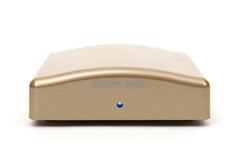
Synergistic Research Holographic Fuses

Synergistic Research

$249.95 USD 

Description

Brand new - in stock - shipping now

The new Holographic Fuse throws the largest soundstage of any fuse Synergistic Research has ever built, roughly fifty percent larger than the Pink Fuse. Images migrate outward into a bigger room, decay extends further, and resolution stays high without ever turning etched or fatiguing. Musical and resolving at once, which is the hardest balance in audio to strike.

It was born inside the Quark streaming server, where closing the gap to SR's flagship Voodoo server called for a UEF metamaterial more aggressive than anything in SR's catalog. Applied to a fuse body, it became the new foundation of the SR fuse lineup: one Master Fuse at the leading edge, Holographic Fuses everywhere else. Start with one, let your system tell you how far to take it, backed by our 30-day money-back guarantee.

A Breakthrough Born Inside the Quark

SR weren’t trying to build a better fuse — not at first.

SR were trying to solve a specific problem inside the Quark streamer server — the most ambitious attempt to bring the performance of the Voodoo, the flagship streaming server, into a more accessible architecture. The Quark uses a lower-power CPU and motherboard than the Voodoo by design. That more modest computing platform generates its own MHz-GHz noise profile — and the gap between the Quark and the Voodoo needed to be bridged through field management rather than raw computing power.

The performance marker for Voodoo is specific. A huge analog soundstage. Absent the glare and edge that has defined digital sound for forty years. That was the target. That was what the Quark needed to approach.

To get there SR needed a UEF metamaterial formulation more aggressive than anything they had developed before. SR needed it to maximally affect the MHz-GHz contamination generated inside the Quark’s circuit — absorbing it before it could migrate outward and degrade the noise environment the analog stages operate inside. Working with a custom AI engineering system built on three decades of SR materials research and design principles, SR developed a four-part compounded UEF metamaterial that SR would not have arrived at through conventional material science alone. If SR had reached it without AI assistance it would have taken many years.

When SR applied that UEF metamaterial formulation to a fuse body — the Holographic Fuse was born.

What it sounds like

The Holographic Fuse throws the largest soundstage of any fuse Synergistic Research has ever made. In SR's reference system, the spatial envelope is roughly fifty percent larger than the Pink Fuse it replaces. That is a listening judgment made by the people who designed the product, in the room they designed it in, using ears that have been trained on this specific comparison for months. Not a subtle difference. A structural one.

SR fuses have always been known for holographic soundstage presentation. The Pink Fuse produced a genuinely three-dimensional image — with depth, width, and spatial resolution that distinguished it from everything else in the category. The Holographic Fuse takes that existing three-dimensional envelope and expands it by approximately fifty percent. The images that were already floating in space migrate outward into a significantly larger room. The decay extends further before it resolves. What the Pink Fuse did well, the Holographic Fuse does on a larger scale — with more air, more sense of physical space surrounding each image, more of the recording environment present in the listening room.

The resolution is high. But it never becomes etched. Never fatiguing. The detail is presented inside a large liquid space. The Pink Fuse by comparison was more pinpoint — tighter imaging, more leading-edge definition, less liquid in its presentation, and in some systems capable of registering as fatiguing over extended listening. The Holographic Fuse is the opposite pole. Same resolution. Larger space. More liquid character. Zero fatigue. Musical and resolving simultaneously — the hardest combination to achieve and the one most fuses fail at.

How fuses alter the sound

How fuses alter the sound of your system. For over one hundred years people believed electrons flowed like water through a pipe and that once ‘contaminated’ by miles of wire, there was little or nothing that could be done to ‘clean’ the electricity feeding your components. Consider this: the electricity feeding your system’s components first propagates through a single fuse. This is why significant gains in sound quality are possible when you insert SR Pink or Master Fuses into each of your components.

Today physicists understand electrons don’t flow at all but rather propagate in a wave of energy that moves along a conductor with a multitude of factors that alters this wave at the quantum level. To understand how electricity travels without electrons ever leaving their respective atoms it is helpful to consider the spectator ‘wave’ at a football match. Even though you can clearly see a wave pattern moving from spectator to spectator as fans raise and then lower their hands (without hands jumping from one person to the next), so too does electricity ‘move’ without electrons ever leaving their atoms. Synergistic Research isolated key factors that affect how electricity propagates by changing the behavior of electrons through Inductive Quantum Coupling methods SR collectively calls UEF Tech. In fact, UEF Tech is so powerful even an electrical chain several miles long is fundamentally improved with nothing more than a single fuse engineered with SR's patented UEF Technology.

Videos

Our Partners